
Five stars can look powerful but paying for them can create more problems than expected. If you plan to buy 5 star Google reviews UK, the real question is not just the price. You need to know whether those reviews are genuine, allowed by Google and safe under UK law. Actually, paid reviews can promise a quick rating boost but they cannot guarantee better Google rankings. At the same time, fake or misleading reviews can lead to removal, account restrictions and legal risks. On the other hand, genuine reviews build trust without creating the same problems. At this point, it makes sense to compare the real cost, seller claims, risks and safer options before paying.
So, how can you overcome these barriers before you buy 5 star Google reviews UK? Let’s break down the risks, costs, ranking limits and safer options.
What Does It Really Mean to Buy 5 Star Google Reviews UK?
To buy 5 star Google reviews UK means paying for ratings or written reviews on a Google profile. Sellers usually group these offers by amount, location, speed or writing style. Some promise UK-targeted accounts. Others offer custom comments, drip-feed delivery, replacements or non-drop claims. Basically, the buyer pays for review activity rather than feedback from a normal customer.
Here is the key point. A real Google account does not make a review genuine. A real person can still post feedback about a business they never used. Under UK law, a fake consumer review does not reflect a genuine experience. So, the real customer experience matters more than how convincing the account or review looks.
The same concern applies when businesses buy Google reviews UK through a paid service. Stars alone do not prove real customer value. Account age, UK location and custom wording also do not prove a genuine visit. If the reviewer never used the business, polished wording changes nothing. That is why seller claims need careful checks before money changes hands.
Why Do UK Businesses Consider Buying Google Reviews?
Some UK businesses think about buying Google reviews because they want a faster change. A new profile can look weak beside older competitors. Also, a small number of low scores can quickly bring the average down. Happy customers may forget to leave feedback too. As a result, paid reviews can look like a quick fix for the profile.
The pressure usually comes from a few clear problems:
- Weak rating: A few low scores can reduce the average.
- Low review count: A new profile can look less established.
- Competitor pressure: Nearby businesses may show far more reviews.
- Slow customer response: Happy customers often forget to leave feedback.
- Speed: Paid packages promise a faster visible change.
But why is this important? Businesses may compare the speed of paid reviews with slower organic growth. Still, that does not show the full picture. You should also look at cost, removal risk, policy risk, legal risk and trust. In real terms, a fast rating rise has little value if the reviews disappear soon after. It matters even less if the profile then runs into a wider issue.
Can I Pay to Get Google Reviews Legally in the UK?
Paying for fake Google reviews can create a clear UK consumer law risk. Since 6 April 2025, UK law has dealt with fake review practices more directly. The key law is the Digital Markets, Competition and Consumers Act 2024. Schedule 20 covers fake reviews, hidden incentives and services that support banned review activity. It also covers asking someone else to post fake reviews.
The legal test is not difficult to understand. A fake consumer review claims to reflect a real experience when it does not. So, using a real person does not solve the problem. Similarly, paying an outside agency does not remove the buyer’s role. UK guidance warns businesses against commissioning fake reviews. Put simply, outsourcing the work does not make the review genuine.
Current CMA action is also important here. The CMA opened five investigations about reviews in March 2026. Autotrader, Feefo, Dignity, Just Eat and Pasta Evangelists are part of these cases. As of 28 September 2026, the relevant investigations were still open. Still, this does not prove that any business has done something wrong. Only a final finding can decide that.
The CMA also has stronger powers under the newer consumer law system. For proven consumer law breaches, fines can reach 10% of global turnover. That is a maximum, not an automatic fine in every case. So, what should you take from this? Treat legal risk as part of the buying cost, not as a small note after the price.
Does Google Allow Paid, Incentivised or Purchased Google Reviews?
No. Google does not allow paid or incentivised reviews that break its real-experience rules. Its Maps policy says reviews should reflect genuine experiences and remain fair. Reviews paid for directly or in kind fall under fake engagement. Discounts, free goods or free services can also cause problems when linked to reviews. Basically, payment can change the nature of the feedback.
Google’s rules cover more than cash payments:
- Paid reviews: Money or value is exchanged for feedback.
- Incentives: Discounts, free goods or services influence the review.
- Selective requests: Only likely positive reviewers are approached.
- Negative-review pressure: Critical feedback is discouraged.
- Rating manipulation: Review activity is used to shape ratings.
This is where UK law and Google policy deal with the issue differently. Legal disclosure does not mean Google must accept an incentivised review. Practically, businesses should avoid fixed star requests or scripted praise. Customers should stay free to praise, criticise or give a neutral view. The aim should be honest feedback, not a planned five-star result.
What Can Happen When Google Detects Purchased Reviews?
If Google detects purchased reviews, it can remove them and restrict the Business Profile. The action can go beyond deleting one review. A profile can stop receiving new reviews for a time. Existing reviews can also become hidden. Google can also show a warning that it removed fake reviews. That warning can then become visible to future customers.
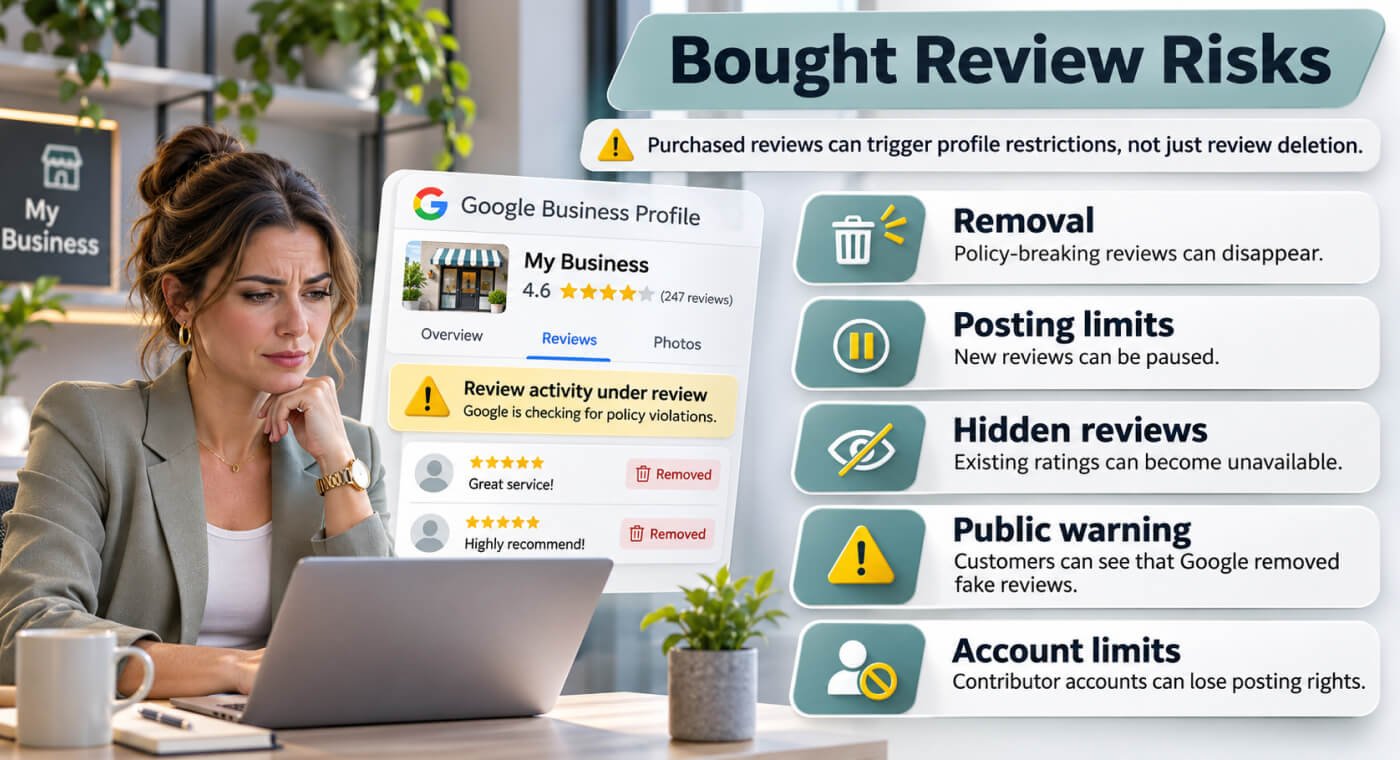
Possible actions can affect the wider review profile:
- Removal: Policy-breaking reviews can disappear.
- Posting limits: New reviews can be paused.
- Hidden reviews: Existing ratings can become unavailable.
- Public warning: Customers can see that Google removed fake reviews.
- Account limits: Contributor accounts can lose posting rights.
Google reported major review enforcement during 2025. It blocked or removed more than 292 million policy-breaking reviews. It also restricted posting on more than 782,000 accounts. More than 13 million fake Business Profiles were removed. Google published those figures in April 2026. Still, Google does not claim it catches every bad review.
This matters because Google does not publish its full detection process. Its policy does say that unusual review numbers or patterns may be seen as rating manipulation. For that reason, claims about “undetectable” reviews should not be taken at face value. Similarly, spreading reviews out over time does not make a false experience genuine. The timing does not change what happened.
Can Buying Google Reviews Really Improve Your Google Maps Ranking?
Buying Google reviews does not guarantee a higher Google Maps ranking. Reviews can support local visibility but Google uses more than review count. Local results mainly depend on relevance, distance and prominence. Review count and review score can also help local ranking. Still, that does not make paid reviews a reliable SEO method.
This matters because local search is not controlled by reviews alone. Google also says businesses cannot pay Google for better local ranking. So, if you plan to buy 5 star Google reviews UK, can they really improve your ranking? The reality is that no seller can guarantee that result. Distance and relevance still matter. Policy-breaking reviews can also disappear, which can remove any short-term gain.
It is also important to avoid unsupported SEO claims. Google does not publish exact ranking weights for reviewer age or review speed. It also does not confirm exact weights for review wording. The same caution applies to location and reply speed. Basically, these ideas should not be presented as proven ranking facts. Good SEO writing keeps official guidance separate from theory.
How Many 5 Star Reviews Do You Need to Go Up on Google?
There is no fixed number of five-star reviews that guarantees a higher Google position. Google uses several local ranking factors, not one review target. Relevance, distance and prominence all matter. More reviews and better ratings can help. Still, Google does not publish a magic number. So, no seller can promise that ten, twenty or fifty reviews will move you higher.
You can still estimate how many five-star reviews you need for a target average. Use this formula: Reviews needed = Current reviews × (Target rating − Current rating) ÷ (5 − Target rating)
For example, suppose a business has 50 reviews and a 4.2 average. It wants to reach 4.5. The calculation is 50 × 0.3 ÷ 0.5. That equals 30. So, the business needs about 30 new five-star ratings, assuming no other ratings arrive. This simple maths turns a vague rating goal into a clear target.
But why is this only an estimate? Google’s displayed average can involve rounding. New ratings can also change the maths while reviews arrive. To stay on the safe side, always round the required result up to the next whole review. Most importantly, this formula estimates a target rating. It does not predict a Google Maps position. Those are two different questions.
How Much Is a 5 Star Google Review Worth?
A five-star Google review has no fixed cash value. Its worth depends on the business and customer value. For example, one café customer might be worth about £4 to £11. A plumbing customer could be worth £300 or more. In practice, a review can create financial value when it helps influence a real customer’s decision.
Here are some illustrative examples based on the figures we reviewed:
| Business Type | Example Customer Value | Possible Value Influenced by One Review |
| Coffee shop or bakery | £5–£10 | £5–£30 |
| Barber or nail salon | £20–£75 | £30–£190 |
| Restaurant or pub | £15–£60 | £15–£150 |
| Garage or car detailing | £90–£265 | £60–£380 |
| Plumber or electrician | £300–£760+ | £300–£760+ |
These figures are examples, not fixed UK averages. Businesses with higher customer values can gain more from genuine reviews. However, one review doesn’t guarantee a set amount of revenue. Its real impact depends on whether it helps influence a customer’s choice.
Cheap offers can look attractive to businesses looking to buy Google reviews cheaply. Some paid review offers work out at roughly £4 to £38 per review. Yet the seller price doesn’t match the business value. A cheap review that disappears offers little lasting benefit. More seriously, fake reviews can create Google policy and UK legal risks.
Practically, the best estimate should be based on your own customer value. If one customer is worth £500, a genuine review that helps win that customer could be worth a lot. Still, you cannot prove that one review caused the sale. So, treat these figures as useful estimates, not guaranteed returns.
What Do Claims Like Real, UK-Based, Safe and Non-Drop Actually Mean?
Claims such as real, UK-based, safe and non-drop do not all mean the same thing. Sellers often use these terms to describe different parts of their service. However, none of them alone proves a genuine customer experience. The key question is simple: did the reviewer actually use the business? UK law focuses on that point.
Common seller terms can mean very different things:
- Real account: The Google profile exists.
- Real person: A human controls the account.
- Real review: The person truly used the business.
- UK-based: Location does not prove a customer link.
- Non-drop: The seller promises replacements.
- Permanent: Sellers cannot control future Google action.
- Drip-feed: Reviews arrive slowly.
- Safe: Marketing words do not equal official approval.
This difference matters when people search for “buy real Google reviews UK”. A real person can still post a fake review. Similarly, a UK-based account does not prove a real visit. The same point applies to 100% Real Business Reviews in the UK. Marketing may describe the account or delivery method but it does not prove a genuine customer experience.
So, where can you buy reviews for Google safely in the UK? Calling a review “safe” does not make a fake review safe. Before you pay, check the total price, minimum order, replacement terms, refunds and support. Also, look for independent public feedback. These checks can expose weak promises. Still, they do not make a fake review legal or Google-safe.
Want to compare your options before making a decision? Explore SMMWISE and see what review services are available for your Google Business Profile.
What Is the Safer Alternative to Buying Google Reviews?
The safer alternative is to pay for review tools, not made-up praise. Businesses can make it easier for real customers to leave feedback without controlling the result. This keeps the genuine customer experience at the centre. It also separates paying for a tool from paying for a five-star rating. The customer still chooses the score and wording.
| Method | What You Pay For | Who Leaves the Review? | Main Difference |
| Purchased review package | Rating or review | Arranged reviewer | The review can lack real experience |
| Review-request software | Request delivery | Genuine customer | Payment covers the collection process |
| Google review link or QR | Easier access | Genuine customer | The tool does not create feedback |
| Reputation management | Monitoring and replies | Existing reviewers | Focus stays on real feedback |
Practically, a simple review process should stay open to honest feedback:
- Ask consistently: Do not screen people by expected rating.
- Use real touchpoints: Link requests to a real purchase or service.
- Make access simple: Use a direct review link or QR code.
- Ask honestly: Do not require five stars or scripted wording.
The key point is customer choice. People should stay free to leave positive, neutral or negative feedback. Google rejects selective positive review requests and incentives. So, if you are researching how to get Google Reviews, focus on real customers. Do not build the process around promised ratings or selected praise.
This approach keeps feedback connected to genuine customer experiences. It also protects trust and supports the long-term health of the Google Business Profile.
Final Thoughts: Should You Buy 5 Star Google Reviews UK?
If you plan to buy 5 star Google reviews UK, look beyond the promise of a better rating. The bigger question is whether those reviews reflect real customer experiences. Paid reviews may improve the visible score for a while but they cannot guarantee better local rankings or lasting results. They can also lead to removal, Google policy violations and UK legal risks.
A better approach is to know how many more good reviews you really need. Then make it easy for real customers to leave honest feedback. Real reviews may take more time to build but they give your profile a stronger base. That way, your reputation grows from real customer experiences instead of numbers that may disappear later.
FAQs About Buy 5 Star Google Reviews UK
1. Can I pay for 5-star reviews on Google?
Google does not allow paid or incentivised reviews. Reviews should reflect a genuine and unbiased customer experience.
2. Can you buy Google reviews in the UK?
Some services may sell Google reviews but commissioning fake reviews is prohibited under UK consumer law. A review must reflect a genuine customer experience.
3. Can Google detect fake reviews?
Yes. Google uses machine learning and human review to detect fake or misleading content. Suspicious review patterns can also trigger action.
4. How common are fake reviews?
There is no reliable figure for Google reviews alone. UK government research estimated that 11% to 15% of reviews in three studied e-commerce categories were likely fake.
5. Can AI detect fake reviews?
Yes. AI and machine-learning systems can identify suspicious review activity and patterns. However, Google also uses human reviewers alongside automated systems.
6. How to trace a fake Google review?
Check the reviewer’s public profile, review history and whether the experience matches your customer records. If the review appears to break Google’s rules, report it through your Business Profile.
7. How to tell if a review is real or fake?
Look for whether the review reflects a genuine experience rather than relying on wording alone. Unusual review volumes or repeated patterns can also be warning signs of manipulation.