
A five-star rating can look like a shortcut to customer trust. But buy reviews for Google can bring more risk than value. Google bans paid reviews that do not reflect genuine customer experiences. UK consumer law also bans certain fake reviews and hidden incentives.
So, what happens when you pay for reviews? You can get stars, custom text and UK targeting. However, Google can remove fake reviews. Your Business Profile can also face restrictions. Legal risk adds another serious cost for UK businesses. The real issue is not how many stars you buy. It is whether those stars come from genuine customer experiences.
Let’s dive deeper and see whether buy reviews for Google really delivers what sellers promise.
What Are You Really Buying When You Buy Reviews for Google?
When you buy reviews for Google, you are often buying more than a star rating. Sellers can offer custom text, photo reviews, UK targeting, city targeting and other extras. Some packages also claim to match your niche or trade.
Common offers include five-star ratings, industry wording and different account types. Sellers can also offer country targeting, bulk orders, subscription plans and multi-location support. Order tracking, review replies, replacement cover and password-free checkout can also appear.
A review package gives you review content, not a real customer. You do not get a genuine purchase, booking or service experience behind the review.
Photo reviews and gradual delivery are common claims too. You may also see terms such as non-drop and permanent reviews. These are seller claims, not Google guarantees. A seller can offer to replace a review after Google removes it. That still does not make the review genuine or allowed. Some sellers also provide review calculators, reply tools, link generators and AI-assisted replies. These tools do not make fake reviews genuine.
Does a Real Google Account Mean a Genuine Customer?
No. A real Google account does not prove a real customer visit or purchase. The account can look old and active. It can also have photos, local details and well-written text. Google says reviews must reflect a real customer experience. It also says reviews should remain genuine and unbiased.
So, one question matters before you trust a review: did this person really use the business? Remember, a real Google account and a real customer are not the same thing.
How Much Do Google Reviews Cost in the UK?
There is no official Google price for reviews. Google does not sell review placements. Sellers set their own rates. A practical UK price range is around £5 to £50 per review. Five-review packages often cost around £25 to £50.
A five-review deal can cost more than one review. However, larger orders often include volume discounts. Photo reviews and custom text can also increase the price. The final cost depends on the seller’s terms.
People searching for buying Google reviews UK can find many package types. Some sellers offer one review while others sell five or more. Bulk plans can reduce the cost per review. Custom text, photos and location targeting can raise the price.
Delivery speed can also affect the bill. The same applies to replacement cover and warranty terms. Refund rules can also include limits. Subscription plans create an ongoing cost instead of a one-off payment.
| Price factor | What the buyer should check |
| Review count | Single review or bulk package |
| Customisation | Text, photos and wording |
| Targeting | UK, region or city |
| Delivery | Start date and pace |
| Warranty | Replacement time and limits |
| Refund | Rules and exclusions |
Do not treat old seller prices as current rates. Prices can change at any time. Price also does not prove a review is genuine, safe or useful.
What Happens When Google Finds Fake Reviews?
Google treats fake reviews as fake engagement. Its policies cover several types of review activity that do not reflect genuine customer experiences.
- Paid reviews: Google does not allow reviews or ratings that people receive payment for, either directly or through other benefits.
- Reviews without real experiences: Reviews must reflect an actual experience with the business.
- Multiple accounts: Google does not allow one person to post content through multiple accounts to boost a business or its ratings.
- Incentivised reviews: Payment, discounts, free goods or free services in exchange for reviews are not allowed.
- Unusual review patterns: A sudden or unusual volume of reviews can indicate rating manipulation.
- Conflicts of interest: Reviews linked to staff, competitors, relatives or other personal or professional relationships can violate Google’s policies.
Google uses automated systems and expert analysts to find policy-violating content. In 2025, Google says it blocked or removed more than 292 million policy-violating reviews globally. It also placed posting restrictions on more than 782,000 policy-violating accounts.
These figures do not mean every bought review will be found. They show the scale of Google’s review checks. The risk can continue after a review first appears.
Can Google remove reviews, restrict your profile and detect fake activity later?
Yes. Google can remove reviews that break its policies. It can also restrict a Business Profile after detecting fake engagement. Restrictions can stop new reviews, hide existing reviews or show a warning about removed fake reviews. Eligible restrictions can be appealed.
A review can stay live for some time before Google takes action. So, seeing a review online does not prove it will remain there. That said, gradual delivery only changes when reviews appear. It does not change the source of those reviews. No delivery plan can create a real customer experience.
Is Buying Google Reviews in the UK Legal in 2026?
Buying fake Google reviews in the UK is illegal. The law bans people from posting or paying for fake customer reviews. It also bans reviews that give an incentive when that incentive is hidden. The Digital Markets, Competition and Consumers Act 2024 sets clear rules for fake reviews. These rules have applied to commercial practices since 6 April 2025.
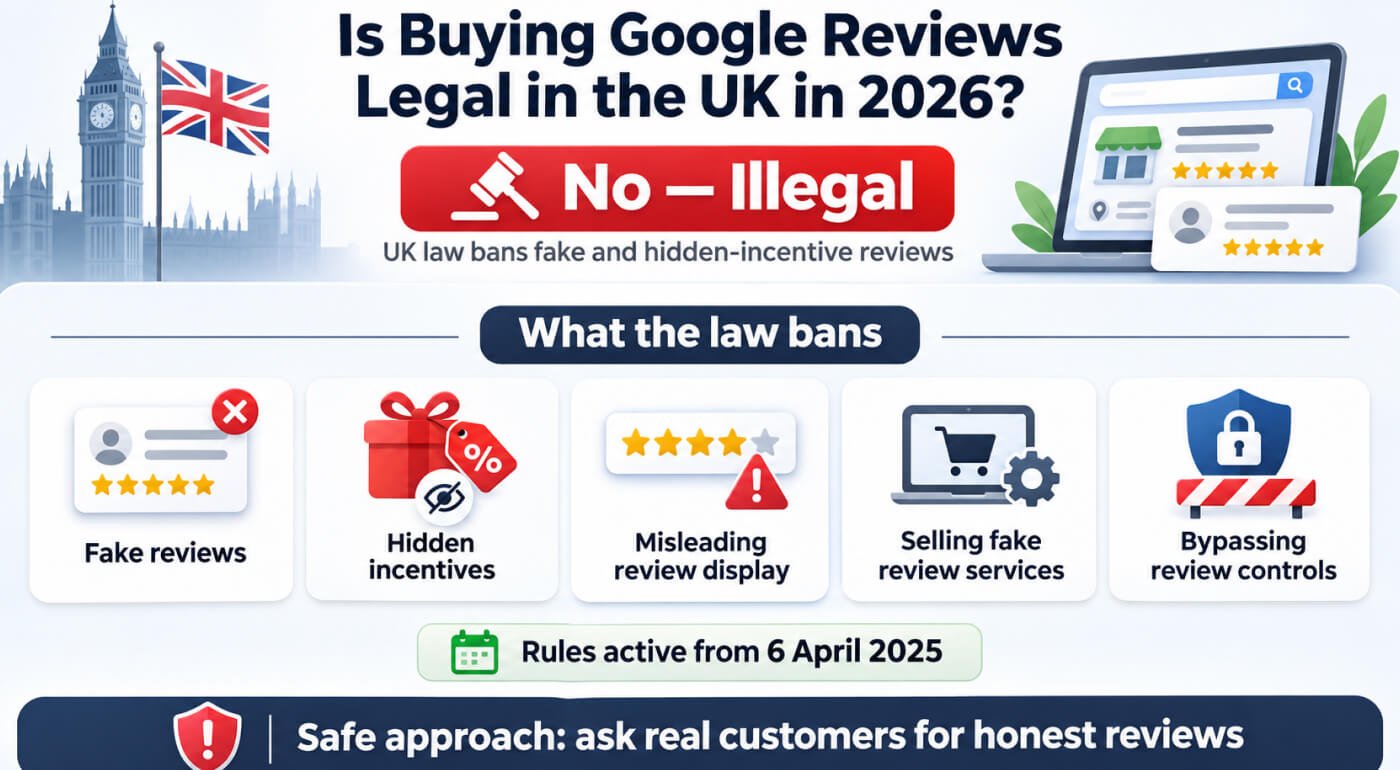
The rules cover:
- Submitting or commissioning fake reviews
- Writing reviews that hide a paid or other incentive
- Publishing reviews or review information in a misleading way
- Offering services that submit, commission or facilitate fake reviews
- Helping traders bypass controls designed to prevent fake reviews
Key dates to know
- 6 April 2025: The new consumer protection rules came into force. Fake reviews and concealed incentivised reviews became banned practices.
- 26 March 2026: The CMA opened five investigations into online review practices involving Autotrader, Dignity, Feefo, Just Eat and Pasta Evangelists.
- 27 March 2026: The CMA announced the five investigations and highlighted its strengthened consumer enforcement powers.
The CMA can enforce these consumer protection rules directly. Businesses that breach the rules can face financial penalties worth up to 10% of their global turnover. However, the March 2026 investigations do not prove that the named businesses broke the law. The CMA had not reached conclusions when it announced the cases.
Are fake, incentivised and genuine reviews treated the same way?
No. Fake, incentivised and genuine reviews are not treated the same way. A fake review does not come from a real customer experience. A genuine review comes from someone who actually used the business.
An incentivised review sits between these two types. The reviewer can be a real customer but the incentive creates extra rules. Under UK consumer law, a genuine incentivised review can be allowed when the incentive is clearly disclosed and the review reflects the customer’s real experience.
However, Google takes a stricter approach. It does not allow payment, discounts, free goods or services in exchange for a Google review. It also bans asking only for positive reviews or requiring specific wording.
So, a review can be genuine without being allowed on Google. UK law and Google’s rules are separate, so businesses need to follow both.
Do Google Reviews Improve Local SEO and Do Bought Reviews Help?
Yes, Google reviews can help local ranking but bought reviews do not guarantee better rankings. Google says reviews are one factor that can affect local search visibility. More reviews and positive ratings can also help a business’s local ranking.
A Google review UK profile does not rank on star ratings alone. Google also looks at how closely the Business Profile matches the search. Accurate business information helps Google connect your profile with relevant local searches.
More importantly, Google says local results mainly depend on relevance, distance and prominence. Reviews form part of prominence but they are only one part of the wider system.
That does not mean buy reviews for Google will improve your position. Google says there is no way to request or pay for a better local ranking. It also gives no Local Pack guarantee for having more reviews.
What Should You Compare Before Paying for a Google Review Service?
Before paying for a review service, check exactly what the package includes. Seller pages often focus on star ratings and delivery speed. However, the full terms tell you much more about the offer.
- What exactly are you buying? Check the review type, text, photos, rating and account claims.
- Where do the reviewers come from? Check what the seller means by real, established or verified accounts.
- What does UK targeting mean? Check whether it means the UK, a specific region or a city.
- What happens if Google removes the reviews? Check replacement limits, warranty terms and refund rules.
- What are the full costs and access needs? Check minimum orders, tracking, support, payment terms and any account requests.
Ultimately, this checklist helps you understand what the seller actually offers. It does not make a fake review legal or acceptable under Google’s policies.
Can You Trust Claims Such as Real, Permanent and UK-Targeted?
You should not trust these claims without checking what they really mean. Terms such as real, permanent and UK-targeted can sound reassuring. However, they do not prove that a review is genuine or safe. A real Google account does not prove a real customer experience. Similarly, ‘permanent’ does not mean a review will stay online forever. No seller can guarantee that a review will avoid future Google action.
| Provider claim | What the buyer should ask |
| Real accounts | Did the reviewer use the business? |
| Verified accounts | What was actually checked? |
| UK reviews | Does the reviewer live or buy in the UK? |
| Permanent reviews | What happens if Google removes them? |
| Non-drop reviews | What are the warranty terms? |
| Safe reviews | Does the review follow Google’s rules? |
| Money-back guarantee | Does it protect the Business Profile? |
More importantly, account age, photos and local details can make a profile look genuine. They still do not prove a real sale, booking or visit.
Could Buying Reviews Create Account or Reputation Problems?
Yes. Buying reviews can create both account and reputation problems. Never share your Google password just because a seller asks for it. Check why they need access and what level of access they actually need. Google says businesses should keep ownership of their Business Profile when using a third-party manager. Each user can have separate owner or manager access, so password sharing is not necessary.
Also, watch for Google impersonation scams. Google will never ask for your One-Time Password (OTP) or Personal Identification Number (PIN). It also does not charge businesses to maintain, verify or reinstate a Business Profile.
Reputation can suffer too. Reviews can use similar phrases or sound unlike real customers. A sudden rise in reviews can also look unusual. People can notice these patterns before Google takes action. Ultimately, a review service should never put your profile ownership or customer trust at risk.
What Other Review Practices Can Put a Business at Risk?
Buying reviews is not the only review practice that can put a business at risk. Google also restricts several ways businesses collect or manage reviews.
- Only asking happy customers: Selective review requests can discourage negative feedback.
- Pressuring customers: Asking for a certain rating or wording can break Google’s rules.
- Offering incentives: Payment, discounts, free goods or services for reviews are prohibited.
- Conflicts of interest: Reviews from staff, relatives or competitors can create policy issues.
- Paying for removal: Money or other benefits should not be offered to remove negative reviews.
The CMA rules also cover fake reviews, hidden incentives and false review details. Instead, invite customers to share honest feedback in their own words.
What Should You Do If Google Removes Reviews?
Start by finding out why Google removed the review. A negative review does not automatically break Google’s rules. Google removes reviews that violate its policies while eligible removal decisions can go through a one-time appeal.
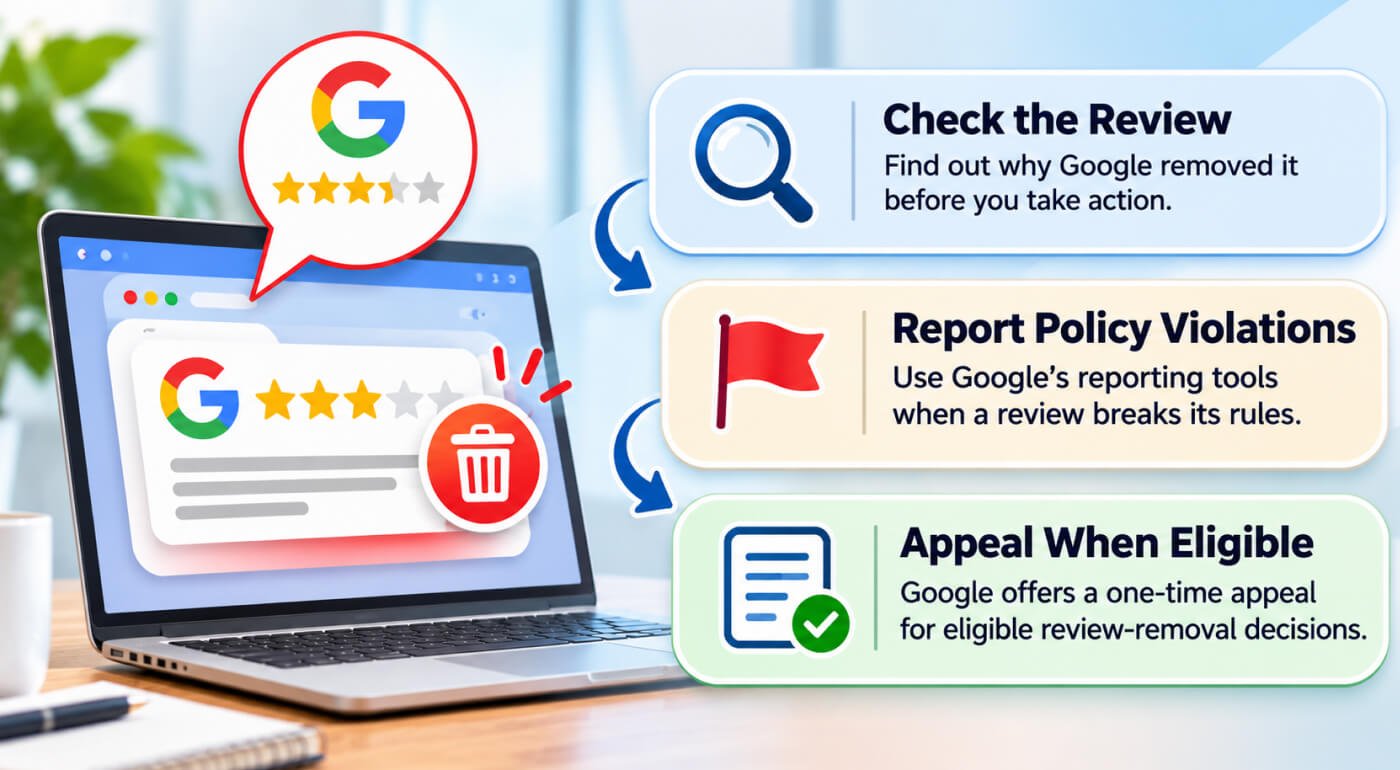
- Check the review: Look at the reason for its removal before taking action.
- Report policy violations: Use Google’s review reporting tools when a review breaks its rules.
- Appeal when eligible: Google provides a one-time appeal for eligible review-removal decisions.
When review extortion is involved, the response is different. Never pay the person or offer money, goods or services to remove the reviews. Google recommends collecting evidence and using its merchant extortion report form.
Keep screenshots, review links and messages that show the demand. Also save dates, times and contact details where possible. These records can help Google investigate the case.
Above everything else, report extortion promptly and keep the original evidence. Google says its extortion reporting process is specifically for cases involving demands for money or favours in exchange for review removal.
How to Get Google Reviews Without Buying Them?
The safest way to get Google Reviews is to make honest feedback easy for real customers. Keep every request neutral and use the same approach across your communication channels. Ask customers to share their genuine experience instead of guiding them towards a specific rating or response.
Google lets businesses create a direct review link or QR code. You can add these links to receipts, thank-you emails, chats and store displays. This gives customers a simple way to reach your review page without searching for the business themselves.
At the same time, businesses can send review requests through email or WhatsApp. SMS can also work when you have permission to contact the customer. Send the request after a real sale, booking or service while the customer still remembers the experience. Physical prompts can support this process too. QR cards, counter signs, table displays, appointment cards and packaging can all make the review link easier to find. NFC tools can also open the review page quickly.
Just as importantly, ask for honest feedback rather than five stars. Avoid telling customers what score to choose or what words to use. Google says honest and balanced reviews can help future customers decide.
How Can a UK Business Build a Review System That Keeps Working?
A simple, repeatable review system helps a UK business collect feedback over time. Instead of relying on one-off review bursts, use a clear process: customer experience → request → link → reminder → response → feedback → improvement. This keeps review requests connected to the customer journey.
A reminder helps when someone forgets the first request. Keep it brief and send it at a useful point. Timing should match the service and customer journey. Staff can send the request after a completed job, booking or purchase.
Automated messages can handle follow-ups and keep the process consistent. QR codes work well in shops and other physical locations. Review monitoring also helps teams reply to customers and spot common issues.
Those patterns can help improve the service too. Repeated complaints can reveal problems with booking, timing, support or communication. Reviews then do more than add stars. They also give businesses useful feedback for improving the customer experience.
What Can Genuine Reviews Give You That Purchased Reviews Cannot?
Genuine reviews offer value that a purchased rating cannot provide. They record a real customer experience and give future buyers useful context. They can also show what customers like, dislike or want to see improved.
| Purchased review | Genuine review |
| Creates a rating entry | Records a real customer experience |
| Can break platform rules | Can follow the rules when requested correctly |
| Can disappear after removal | Builds a genuine review history |
| Gives little customer insight | Provides useful customer feedback |
| Creates policy risk | Supports customer trust |
| Does not guarantee SEO gains | Supports a legitimate profile |
The real value appears when customers point out what needs fixing. It can highlight problems with booking, timing, support, communication or the overall process.
Genuine reviews also help people judge a business before they choose it. At the same time, they give the business useful feedback that purchased reviews cannot provide.
Final Thoughts on Buy Reviews for Google
A five-star rating can look valuable at first but the real cost goes beyond the price. When you buy reviews for Google, a review can disappear, affect customer trust or create problems under Google’s rules and UK consumer law. For UK businesses, both sets of rules matter while the CMA’s 2026 investigations show that review practices remain under scrutiny.
Before paying, ask four simple questions.
- Is the review genuine?
- Does Google allow it?
- Does UK law allow it?
- Will it still bring value in the long term?
In the end, buy reviews for Google can create the appearance of trust but genuine reviews come from real customer experiences and give businesses feedback they can actually use.
FAQs About Buy Reviews for Google
1. Can you really buy Google reviews?
- Yes, sellers offer paid Google review packages. However, Google does not allow reviews that lack a genuine customer experience, including paid reviews.
2. Can Google detect fake reviews?
- Yes. Google uses systems and other checks to identify fake engagement and rating manipulation. Reviews that break its policies can be removed, even after they appear on a Business Profile.
3. Can I pay for 5-star reviews on Google?
- You can find sellers offering five-star review packages but Google does not allow paid reviews. It also prohibits incentives such as discounts, free goods or services in exchange for reviews.
4. How much does it cost to get Google reviews?
- There is no official Google charge for getting customer reviews. Paid review sellers set their own prices, so costs vary by review count, package type and added features.
5. How much is a 5 star Google review worth?
- A five-star review has no fixed financial value. Its real value depends on whether it comes from a genuine customer and gives useful information to future buyers. Genuine reviews can help customers understand a business before choosing it.
6. How to get 1000 Google reviews?
- There is no legitimate shortcut that guarantees 1,000 Google reviews. Build them through genuine customer experiences, neutral review requests and easy-to-use review links or QR codes. Google does not allow fake reviews, paid reviews or review manipulation.