
A strong Google rating can influence a customer before they ever visit your website. When competitors already have hundreds of reviews, catching up can feel urgent. That pressure is why buying Google reviews can look like an easy shortcut.
A quick search for “buy Google reviews UK” brings up plenty of sellers promising fast ratings and stronger credibility. That can sound tempting but the risks are real. Fake or paid reviews can break Google’s rules and create legal problems in the UK.
Real reviews offer something paid reviews cannot. They reflect genuine customer experience, build lasting trust and give your business feedback you can actually use.
Now, let’s dive deeper into the guide and see what buying Google reviews really means for UK businesses.
Is It Legal to Buying Google Reviews in the UK?
Buying fake Google reviews can break UK consumer law. Since April 2025, fake reviews and hidden paid reviews have been specifically banned. Businesses are also responsible for how agencies or contractors collect reviews for them.
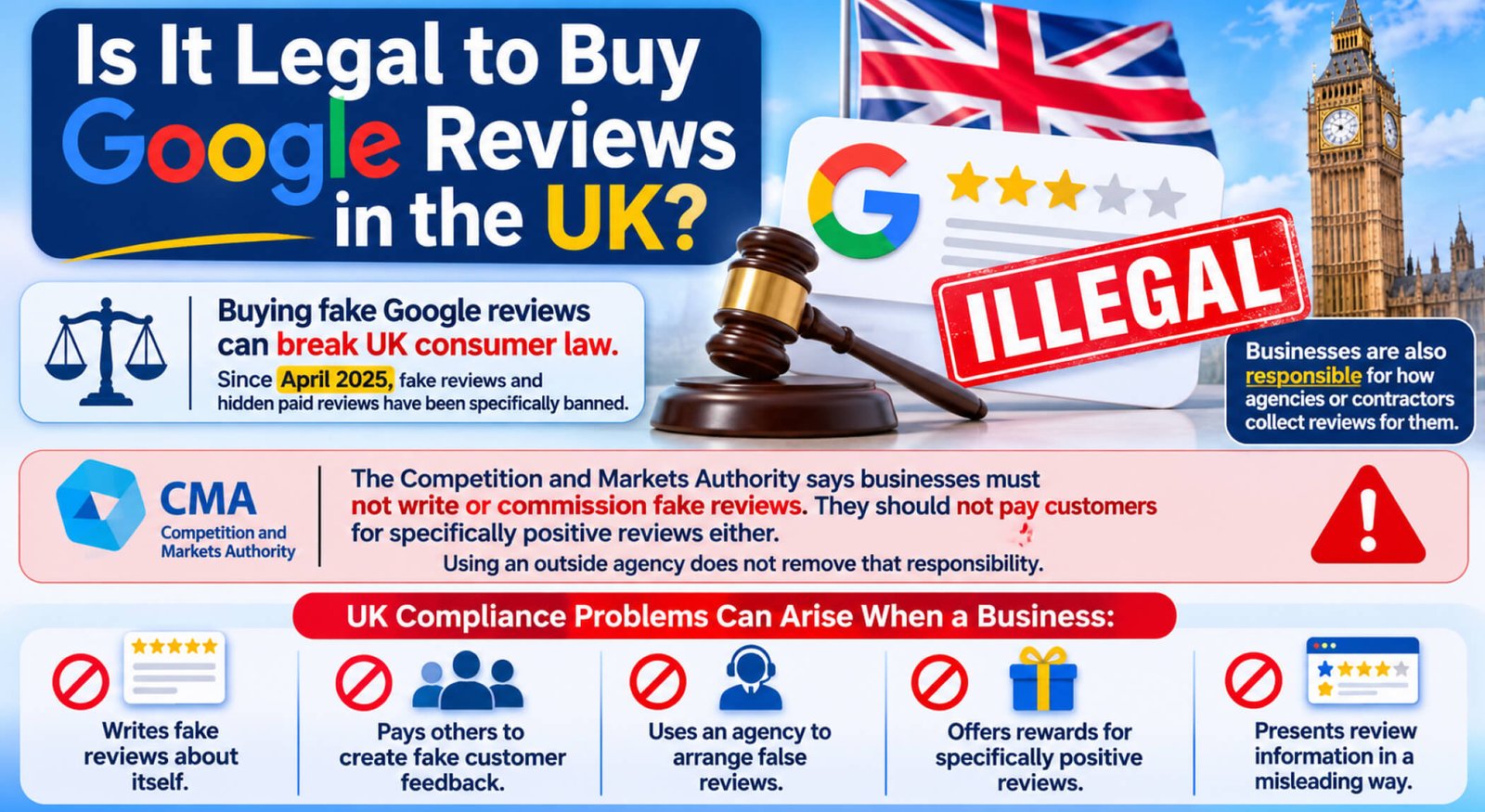
The Competition and Markets Authority says businesses must not write or commission fake reviews. They should not pay customers for specifically positive reviews either. Using an outside agency does not remove that responsibility.
UK compliance problems can arise when a business:
- Writes fake reviews about itself.
- Pays others to create fake customer feedback.
- Uses an agency to arrange false reviews.
- Offers rewards for specifically positive reviews.
- Presents review information in a misleading way.
The CMA can issue fines of up to 10% of global turnover in serious cases. In March 2026, it also opened five investigations into online review practices. However, an investigation does not mean a business has broken the law.
What Are Sites Selling Google Reviews Actually Promising?
Businesses searching for ways to buy reviews for Google usually find sellers focused on speed, appearance and delivery. These services often promise feedback that looks natural and believable. The claims can sound convincing, but they do not prove a real customer experience.
Common seller promises often cover:
- UK-based or city-targeted reviewer accounts.
- Established Google accounts with past activity.
- Custom-written five-star review text.
- Gradual delivery across several days.
- Photo reviews or longer comments.
- Permanent or non-drop guarantees.
- Replacement promises after removed reviews.
- Packages for several business locations.
Here is the key point many sales pages blur. A real Google account is not always a real customer. Natural wording does not prove a genuine experience either. A convincing review can still be fake.
AI-written review text creates the same problem. AI can make fake feedback sound fresh and varied. That still does not create a real visit or purchase. So unique wording should never be confused with authentic Google reviews .
How Much Does It Cost to Buy Google Reviews in the UK?
The cost of paid Google reviews varies between sellers. Larger packages often reduce the price for each review. Extra features can push the price up again. UK targeting and custom text often cost more.
Pricing can change based on:
- The number of reviews ordered.
- Claimed UK or city-level targeting.
- Custom review wording.
- Photos attached to reviews.
- Subscription or repeat-order packages.
- Replacement or retention promises.
But why does price matter if the review breaks Google’s rules? Paying more can give you extra seller features. However, it does not prove the reviewer used your business. So, a more expensive review does not mean it is safe, legal or genuine.
Which Paid Google Review Practices Break Google’s Rules?
Google expects reviews to come from genuine experiences with a business. Paid reviews go against that basic rule. Rewards can also cause problems, including discounts or free products. The review should come from real customer experience, not a reward.
Problematic practices can involve:
- Paying for reviews directly.
- Giving benefits in exchange for reviews.
- Posting reviews without a genuine experience.
- Using several accounts to influence a rating.
- Selectively asking only happy customers for public feedback.
Review gating also needs care. This happens when a business filters customers before asking for a public review. Happy customers get a Google link. Unhappy customers get a private form instead. That can give people a false view of customer opinion.
Employee reviews can create another problem. A staff member can have a real Google account and still have a conflict. An agency cannot make fake feedback genuine by writing it well. Real identity and real customer experience are different things.
Review tricks are not only about buying five-star comments. They can also use hidden rewards, staff-written praise or blocked bad reviews. In March 2026, the CMA looked into several parts of the review process. However, these are still investigations unless the CMA makes a final decision.
Can Google Detect Bought Reviews and What Happens If It Does?
Yes, Google says it works to detect and remove fake review activity. Its exact detection systems are not public. So nobody outside Google can promise a review will stay hidden. Claims of 100% safety should be treated with care.
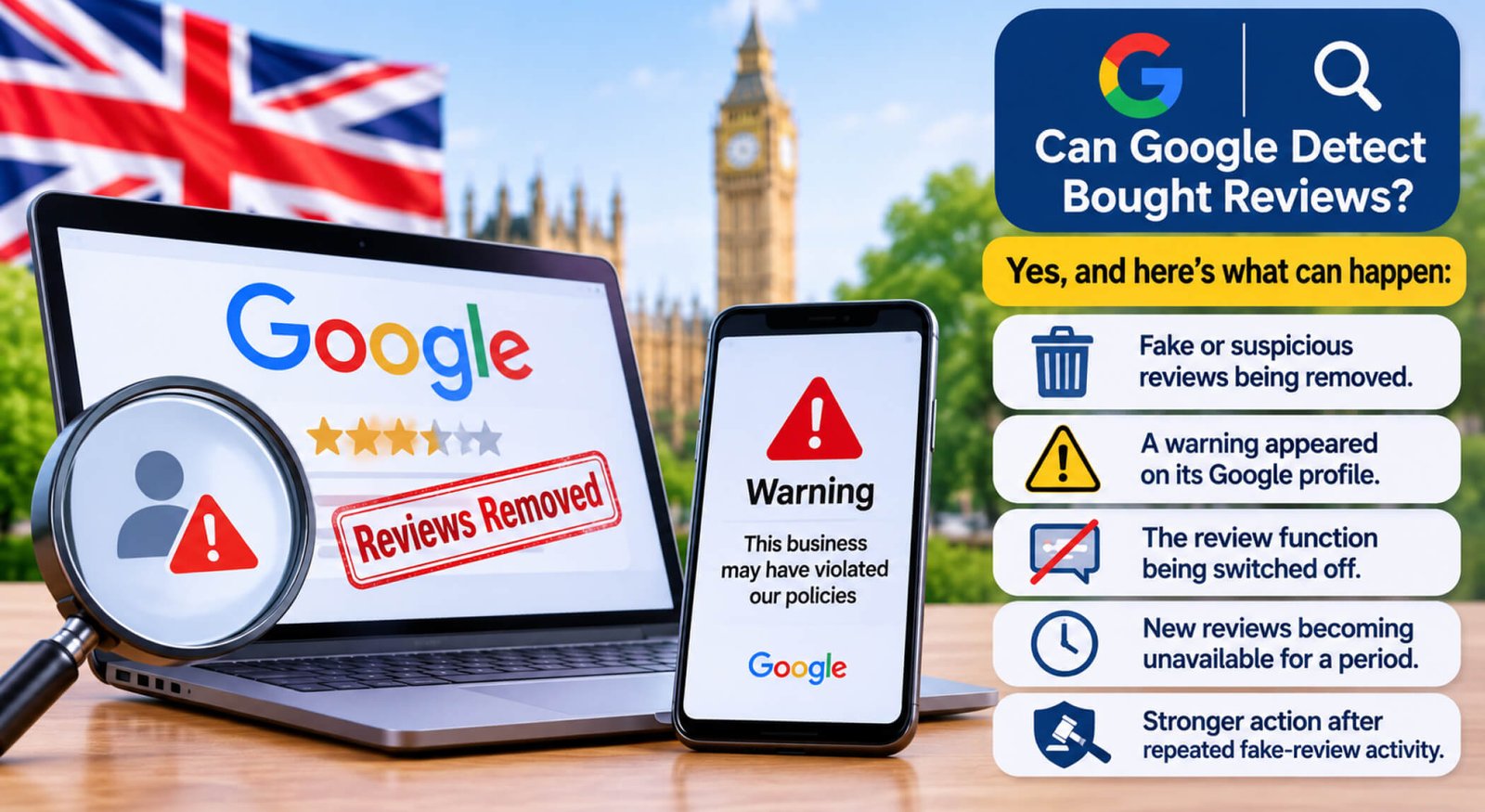
For UK businesses, the effect can go beyond one deleted review. Google made formal promises to the CMA in January 2025. Those promises increased action against businesses that use fake reviews. They also target repeat fake reviewers.
A business can face outcomes such as:
- Fake or suspicious reviews being removed.
- A warning appeared on its Google profile.
- The review function is being switched off.
- New reviews becoming unavailable for a period.
- Stronger action after repeated fake-review activity.
The most serious UK detail is easy to miss. Repeat offenders can lose all reviews for six months or longer. That can affect the full review profile, not only paid feedback. A quick rating boost can put real review history at risk.
Google also promised better checks and easier methods to report fake reviews. A review that is up now might potentially be taken down later. If it takes a long time to remove, then the review is not real. Saying “it stayed up” therefore isn’t a safe approach to judge a review.
Do Bought Google Reviews Actually Help Local SEO?
Bought Google reviews are not a safe shortcut for local SEO. Reviews can support local visibility but Google uses more than review numbers. Business relevance, location and wider prominence also matter.
Because of that, genuine reviews are more valuable than simply increasing the total count. They can build trust and support a stronger local presence. Paid review activity can put that trust at risk, especially when the signals are not genuine.
This is where many businesses get confused. More reviews do not always mean better results. The real value comes from useful and trusted signals, not just a higher review count. That is also why guaranteed Google Maps ranking raises concern. No seller controls Google’s local ranking systems. A paid review package cannot guarantee a top position.
What Are the Red Flags of Google Review Sellers?
Seller websites often make big promises because these promises can attract buyers. Clear guarantees can sound safe and reassuring. However, only Google controls how it checks reviews later. So promises of total safety should be treated with care.
Watch carefully for claims such as:
- 100% permanent Google reviews.
- 100% undetectable purchased reviews.
- Guaranteed Google Maps rankings.
- Guaranteed retention with no realistic limits.
- Claims that aged accounts make reviews safe.
- Unverifiable success or retention percentages.
- Vague promises about UK reviewers.
- Unclear replacement or refund terms.
What Does a UK Google Review Actually Mean?
The phrase UK review can mean several different things. A Google review UK package often means some form of UK targeting. It could mean a UK account or a UK IP address. It could also mean a real UK customer.
The difference matters because a UK location does not prove a real customer visit. Did the reviewer really use the business? A UK-based account can still have the same trust problem without real experience. So location alone should not be used as proof.
Is Buying Google Reviews Worth It for a UK Business?
Buying Google reviews offers one clear benefit: speed. A seller can promise activity faster than normal customer outreach. However, that speed brings legal, policy and trust risks. The business also gets very little useful customer feedback.
| Factor | Bought reviews | Genuine customer reviews |
| Speed | Usually faster | Builds gradually |
| Genuine experience | Often missing | Based on real customers |
| Google policy risk | High | Low when collected correctly |
| UK compliance risk | Can apply | Lower when collected fairly |
| Customer insight | Very limited | Useful feedback |
| Long-term reliability | Uncertain | Stronger foundation |
Genuine reviews do more than increase your review count. They show what customers like and where your service needs to improve. They also help new customers decide if they can trust your business. Paid praise cannot give the same value.
So, is buying reviews worth it? For most UK businesses, the risk is bigger than the reward. A quick rating boost can lead to trust and compliance problems later. Genuine reviews take more time, but they can build stronger value for the future.
What Should You Do If You Have Already Bought Google Reviews?
If you have already paid for reviews, do not make the problem worse. Buying more reviews to replace removed ones can repeat the same risk. Start by checking what you paid for and who arranged it. Then, move future review requests back to real customers.
A sensible clean-up process looks like this.
- Stop purchasing extra reviews.
- Identify any agency or freelancer involved.
- Keep records of what your business commissioned.
- Avoid repeatedly replacing reviews that disappear.
- Check your Business Profile for warnings or restrictions.
- Move review requests back to genuine customers.
- Review how staff and agencies ask for feedback.
If Google applies a restriction, use its appeal process where needed. Speak with a legal adviser if the risk looks serious. This article gives general information, not personal legal advice. The right action depends on what happened.
Can You Pay for Google Review Management Without Buying Reviews?
Yes. Paying for review management is different from buying reviews. A business can pay for software or expert help to ask real customers for feedback. So, the main difference is what you are paying for.
| Service | What you pay for | Key point |
| Review seller | Reviews themselves | High policy and legal risk |
| Review software | Tools for genuine review requests | Can support fair collection |
| SEO or marketing agency | Managing genuine review outreach | Must still follow UK rules |
The CMA gives clear guidance to PR, marketing and SEO companies. Agencies should not write or arrange fake reviews for clients. Businesses also need to check that outside partners follow the rules. Both sides can face problems when fake reviews are ordered.
This difference matters for small businesses. You can pay to make the review process better without buying fake praise. Good review management makes it easier for real customers to leave feedback. However, it should never be used to create fake customers.
How to Get Google Reviews Without Buying Them?
Getting Google reviews safely is about using the right process, not a trick. Ask real customers for feedback at the right time. Also, make the review step simple without telling them what to say. This keeps the feedback honest, useful and easy to trust.
A practical review workflow looks like this.
- Ask after a real purchase, visit or completed service.
- Choose a natural moment while the experience is still fresh.
- Send the customer a direct Google review link.
- Use a QR code where it genuinely saves time.
- Ask for honest feedback rather than five stars.
- Give happy and unhappy customers the same chance.
- Track how many requests become published reviews.
- Respond calmly to positive and negative feedback.
- Use repeated complaints to improve the customer experience.
Timing matters more than clever wording. For example, a tradesperson can ask after finishing the agreed work. A clinic can ask after the appointment ends. An online shop can ask after delivery, not before the parcel arrives.
Keep the request short and neutral. Thank the customer and explain that honest feedback helps other people. Then give them a simple Google review link. Do not tell them which rating or words to use.
Track the process, not only the star score. Look at request volume, response rate and common feedback themes. This shows whether customers can use the link easily. It also turns reviews into useful business feedback.
Final Thoughts: What Is the Better Long-Term Review Strategy?
Buying Google reviews can make a profile look stronger for a short time. But a higher number does not always mean stronger trust. Paid or fake reviews can also bring legal, policy and reputation risks.
The strongest long-term value comes from genuine customer reviews. Real reviews show what customers liked, disliked and expected from your business. They also give future customers a clearer reason to trust what they see.
That is the key difference. Paid reviews can improve appearance but genuine reviews build proof. For UK businesses, genuine feedback is easier to defend, learn from and build on. That makes it a stronger long-term asset than buying Google reviews.
FAQs About What Should UK Businesses Know Paid Buying Google Reviews?
1. Can You Really Buy Google Reviews?
- Yes, you can find websites that sell Google reviews. However, paid or fake reviews can break Google’s rules and UK consumer law.
2. Can Google Detect Fake Reviews?
- Yes, Google says it detects and removes fake reviews and other fake engagement. Businesses linked to fake-review activity can also face review restrictions or profile warnings.
3. Can a Company Buy Google Reviews?
- A company can find sellers offering paid Google reviews but that does not make them legitimate. UK businesses must not write or commission fake customer reviews.
4. How Much Is One Google Review Worth?
- A genuine Google review has no fixed cash value. Its business value depends on customer trust, review quality, competition and how useful the feedback is.
5. How to Get 1,000 Google Reviews?
- Ask genuine customers for honest reviews after real purchases, visits or completed services. Use a direct Google review link or QR code and build reviews steadily over time.
6. How Much Does It Cost to Get Google Reviews?
- Genuine Google reviews are free because real customers can leave them without payment. Businesses can pay for review-management tools but paying for fake reviews creates legal and policy risks.
7. How to Get 500 Google Reviews?
- Create a regular system that asks every genuine customer for honest feedback. Make the process easy with a Google review link, QR code and short review request after each real customer experience.