
The word “real” can hide several different meanings in the review market. A review might come from a real UK account, yet the person may never have used the business. That is why 100% Real Business Reviews in the UK should connect to genuine customer use, not just account identity.
At the same time, many firms compare paid review services to build trust and stand out online. Google looks for genuine customer experience. UK rules also cover fake, paid and misleading reviews. More reviews can make a profile look stronger, but they cannot promise a better rank. So, firms should know exactly what they are paying for before trusting claims about safety, long-term results or rankings.
Now, let’s look beyond the star rating and see what actually makes a review genuine.
What Makes 100% Real Business Reviews in the UK Truly Genuine?
A genuine business review comes from someone who has actually used the business. A real account alone cannot prove that. A real person can still review a service they never used. Similarly, a verified buyer can show that a sale took place. However, the review still reflects that person’s own experience and opinion.
So, account identity and real use are not the same thing. The clearest way to understand this is to look at five review types.
| Review type | What it means | Does it prove real use? |
| Real account | A genuine online account exists | No |
| Real person | A human writes or posts the review | No |
| Verified buyer | A sale or buyer link can be checked | Stronger proof |
| Genuine review | Feedback comes from real use | Yes, in principle |
| Paid review | Money or another reward affects the review | Creates policy and legal concerns |
A real account only proves that the account exists. A real person proves that a human posted the review. A verified buyer gives stronger proof that a sale happened. Meanwhile, a genuine review links back to real use. A paid review can create extra policy and legal concerns.
Google says Maps reviews should reflect genuine use of a place or business. It also bans paid or rewarded ratings. So, a real UK account is only one part of the picture. The better question is simple: did the person actually use the business they reviewed? If not, the account itself does not prove the review is genuine.
Why Do Businesses Consider Buying Google Reviews in the UK?
Businesses often consider buying Google reviews in the uk when their profile looks weaker than nearby competitors. Low review numbers, slow feedback and poor first impressions can all create pressure. Generally, the issue is not always poor service. Many happy customers simply leave without posting a public review.
This can make a good business look less active online. In a busy local market, that difference can affect how people view the business.
Several common pressures drive this search:
- Low review numbers: A new business can look less established beside a rival with many ratings.
- Slow buyer replies: Real buyers often forget to leave feedback after a good job.
- Poor first impressions: A weak rating can shape trust before someone makes contact.
- Strong local competition: Busy markets can make a small review profile look less convincing.
- Bad review pressure: Owners sometimes want to balance a harsh or disputed rating quickly.
These pressures explain why buying Google reviews attracts strong buyer interest. However, demand does not decide what Google or UK law allows. So, businesses should look beyond the sales pitch. The key question is simple: who writes the review and why?
Can I Pay to Get Google Reviews?
Yes, you can pay for review support but paying for the review itself is different. Review support can cover software, text requests, QR codes, tracking and reply help. These tools help real buyers share their own views. They do not need to influence what the buyer says.
Paid review posting works in a different way. Money, discounts, free goods or other rewards can change the rating or words. Google does not allow paid or rewarded reviews on Maps. However, businesses can still ask real buyers for honest feedback. So, the business should not choose the score or tell the buyer what to write.
So, what should you check before paying a provider? Ask exactly what your payment covers. Does the firm help you reach real buyers? Or does it supply the reviews itself? Basically, that one question can reveal a lot. It shows whether you are paying for review support or paying for public praise.
Is Buying Google Reviews in the UK Legal?
Buying Google reviews in the UK can create legal risk if the reviews are fake or misleading. Since 6 April 2025, several fake-review practices have been banned under UK consumer law. The CMA says businesses should not write fake reviews. They should not ask third parties to write them either. Agencies can also face risk when they arrange fake review work for clients.
The legal issue goes beyond fake accounts. UK guidance also covers commissioned fake reviews, hidden incentives and misleading review information. It also applies to businesses that publish consumer reviews. Practically, a real person does not automatically make a review lawful. A real UK account does not do that either. The facts behind the review still matter.
You also need to be careful when talking about fines. One bought review does not automatically mean a 10% penalty. That is not how the rules work. However, serious breaches of consumer law can lead to large fines. CMA guidance says fines can reach 10% of global turnover. Some cases can also bring criminal risk.
What Should You Check Before Choosing a Google Review Service?
Before choosing a Google review service, check exactly what the provider sells and how it works. Words such as real, verified, safe, or permanent can mean different things. So, do not rely on the headline alone. The process behind the service tells you much more.
Use these checks before paying:
- What does real mean? Ask if it means a real account, real person, or real buyer.
- Did the person use the business? Real use matters more than account location alone.
- What are you paying for? Review support and review posting are not the same.
- Does the provider promise rankings? No provider can promise a Google local position.
- Does it promise permanent reviews? Google controls what stays on its own platform.
- What happens after removal? Read refund, replacement and service terms with care.
- Does it need account access? Avoid giving access that the service does not need.
Here is why this matters. A provider can use a UK account without proving the person was a real buyer. Similarly, slow delivery does not prove that each person used the business. The timing can look natural, but the source can still be the same.
So, what should you judge? Look at what happens behind the scenes. Do not judge the service only by how the final review profile looks.
Is your Google profile missing the trust customers look for? Then see how SMM Wise can help strengthen your online presence.
Can More Google Reviews Improve Local Rankings?
Yes, more reviews and good ratings can help local search but they do not guarantee a higher rank. Google says local results mainly depend on relevance, distance and prominence. Its guidance also says more reviews and good ratings can help local ranking. However, businesses cannot pay Google for a better local position.
So, how much do reviews really matter? Reviews are only one part of local search. Correct business details matter too. The right category also matters. Location and wider web signals also play a part. For this reason, buy 5 star Google reviews UK should not be treated as a guaranteed SEO shortcut. No fixed number of reviews can promise a certain ranking position.
Is It Safe to Buy Google Reviews in the UK?
Buying Google reviews in the UK is not risk-free. No provider can promise zero risk with paid reviews. Google can remove reviews linked to fake activity. It can also take action against UK profiles when it finds fake review activity. So, businesses should understand the risks before paying for any review service.
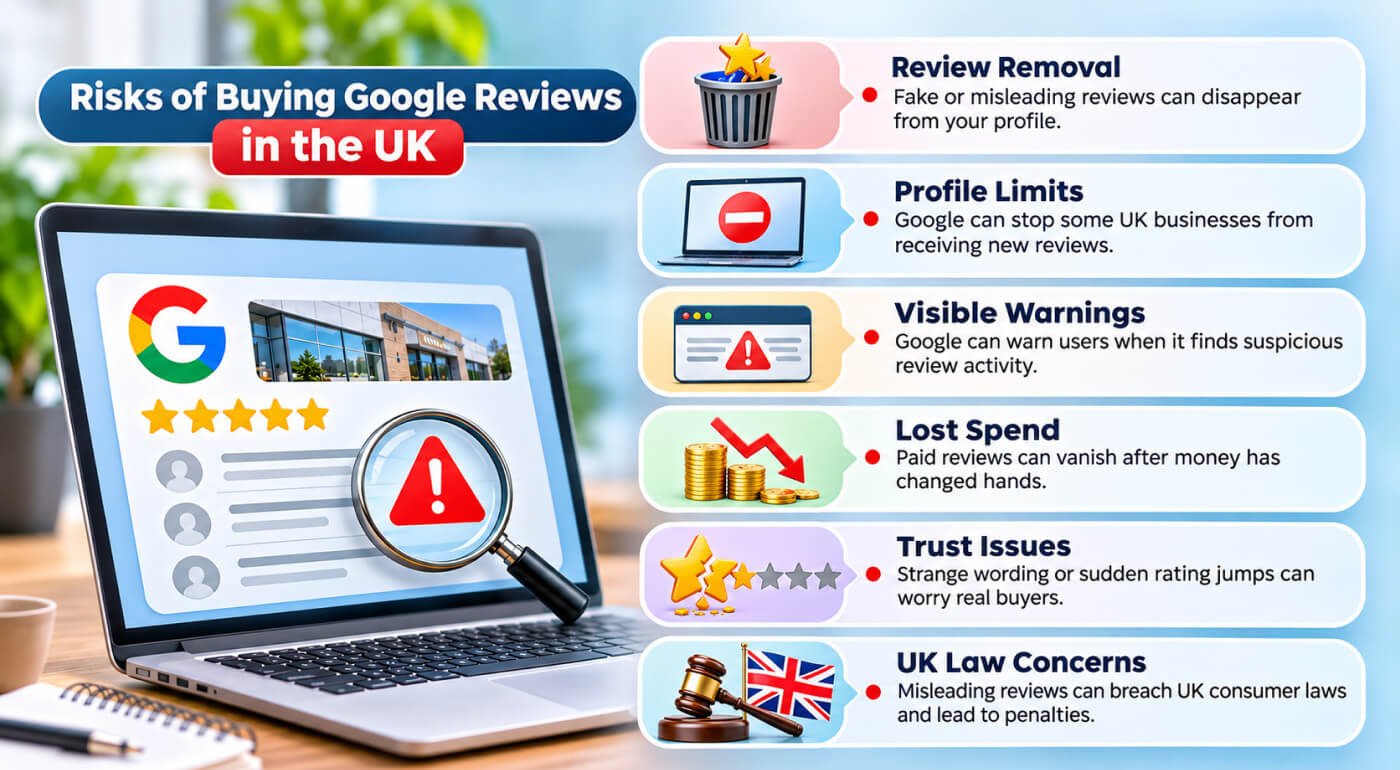
The main risks are practical:
- Review removal: Fake or misleading reviews can disappear from the profile.
- Profile limits: Google can stop some UK businesses from receiving new reviews.
- Visible warnings: Google can warn users when it finds suspicious review activity.
- Lost spend: Paid reviews can vanish after money has changed hands.
- Trust issues: Strange wording or sudden rating jumps can worry real buyers.
- UK law concerns: Fake or misleading review activity can create consumer-law risk.
The CMA says Google can add warnings to affected UK profiles. Google can also switch off new reviews in some cases. Repeat fake-review activity can lead to stronger action. So, does using real accounts remove the risk? No. The simple fact is that real accounts do not remove these concerns.
How Can You Tell Whether Google Reviews Are Genuine?
You cannot prove a Google review is genuine from one clue alone. A better check looks at the wording, account, timing and business facts together. Generally, patterns give you more useful context than one sentence. UK government research also found that reviewer networks can reveal more than review wording alone.
Look at several clues together:
- Experience details: A service, product, staff member, or place can add useful context.
- Account activity: Odd patterns across many unrelated firms deserve a closer look.
- Timing: Large bursts of similar scores can be worth checking.
- Repeated wording: Near-copy text across several accounts can look unusual.
- Cross-site patterns: Similar themes on other review sites add useful context.
- Business facts: Check whether claims match real services, places and buyer journeys.
But why does this matter? People often judge a review by its writing style. That can lead to poor guesses. A polished review is not always fake. A short review is not always real. Similarly, a five-star score is not false simply because it is positive. You need context, not one easy rule.
The research also gives one useful warning. It studied 2.1 million product reviews across nine UK ecommerce platforms. It estimated that 11% to 15% were fake in three product groups. However, those figures cover product reviews, not local Google business reviews. So, they should not be applied directly to Google Maps.
Where Can Customers Check Real Business Reviews in the UK?
Customers can check business reviews on several trusted UK review sites. Google Business Profile is mainly useful for local firms and Maps searches. Trustpilot helps people check a business or brand more widely. Feefo is useful for reviews linked to real purchases. FreeIndex mainly helps people compare UK local businesses and services. So, each platform has a different main use.
Industry review sites can also give useful detail. Trades, health, travel, software and business services often have their own review sites. Practically, one perfect score should not decide everything. Instead, look for the same points across several sources. Then compare them with the firm’s real services, location, prices and other details. This gives you a clearer view than using one review site alone.
How Can UK Businesses Get More Genuine Google Reviews?
UK businesses can get more genuine Google reviews by making the request simple, fair and routine. Google allows firms to ask real buyers for reviews. It also provides review links and QR codes. The buyer should choose the rating and wording. The business should not push for a set score or message.
A simple review system can work well:
- Ask after real use: Send the request after the job, booking or sale ends.
- Use a direct review link: Cut the number of steps the buyer must take.
- Use QR codes where useful: Shops can add them to receipts or printed cards.
- Ask for honest feedback: Do not tell buyers which star score to choose.
- Make requests routine: Add them to normal buyer follow-up.
- Track the process: Count requests and reviews without controlling the view.
Normally, steady review requests work better than one large push. They keep feedback close to real sales and real work. They also give the business useful information about service quality. So, where should UK businesses get genuine buy reviews for Google? Basically, the best place is their own real buyer base. Those customers already know what the business is like.
Which Google Review Collection Tactics Should Businesses Avoid?
Businesses should avoid any Google review tactic that controls who reviews, what they say, or which score they choose. Google allows fair requests for real customer feedback. However, it bans paid reviews, selective positive-review requests, rewards, conflicts of interest and pressure for set ratings. The aim should be honest feedback, not a shaped result.
Review gating is one clear example. A business may collect private feedback, then send only happy buyers and how to get 500 Google reviews. This can give people the wrong picture. Similarly, offering a discount for a five-star review can change why someone posts it. Asking staff to collect a set number of five-star reviews can also put pressure on them.
Pre-written praise can also cause problems. Buyers should write reviews in their own words. So, what should businesses do instead? Ask for honest feedback in a fair way. Give buyers time to share their own views. Let each person choose a score that fits their experience. This keeps the review based on the customer’s real view. It does not rely on words given by the business.
Should You Buy Positive Reviews to Offset a Fake Negative Review?
Buying positive reviews is not the right way to deal with a fake negative review. If a review clearly breaks Google’s rules, report it through the proper route. If the review comes from a real buyer dispute, reply with care. Focus on the facts instead of trying to cover the score with paid praise.
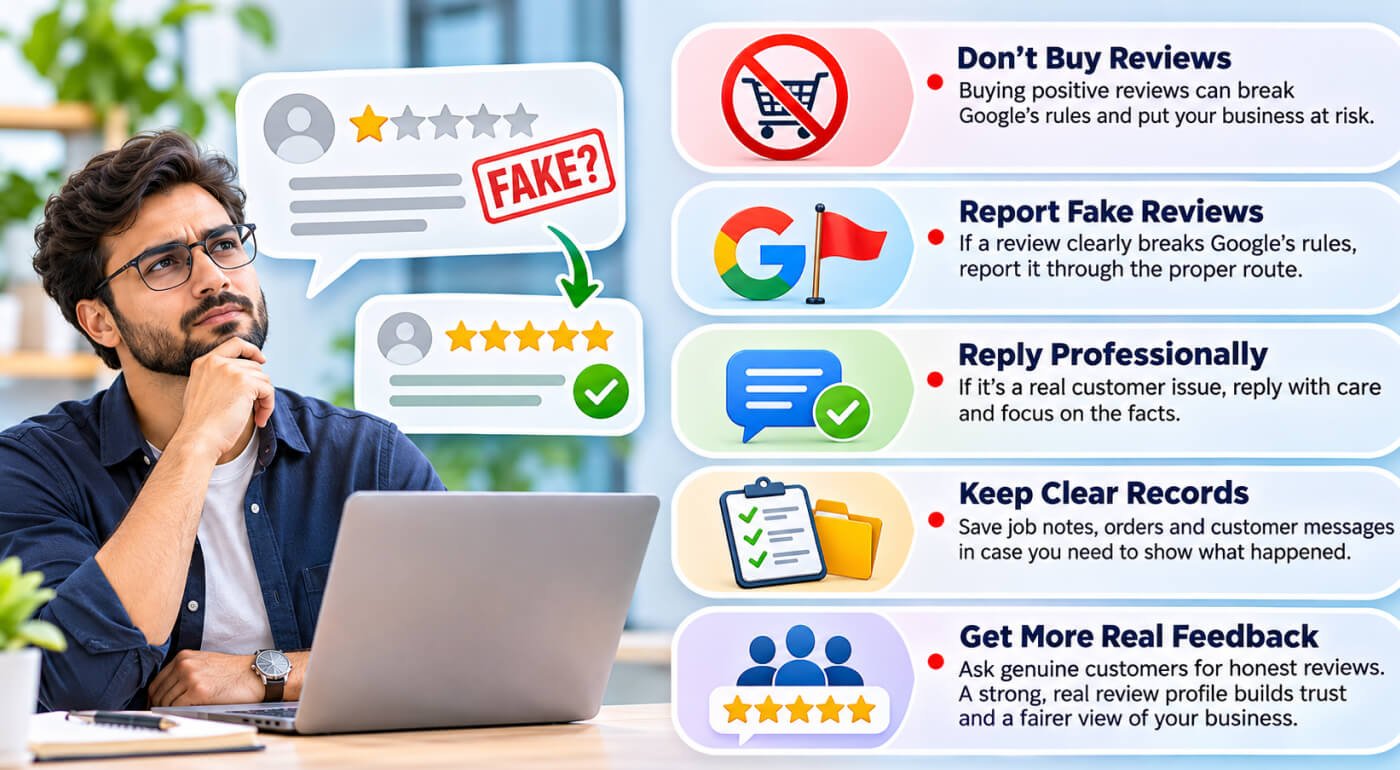
But when is a negative review actually fake? A bad review is not fake simply because the business disagrees with it. Real buyers can have poor visits, mixed views, or high hopes. A business can still disagree with their opinion. However, honest criticism should not be called fake only because it lowers the star score.
If a review looks false, keep any useful records. Job notes, orders and buyer messages can help show what happened. At the same time, keep asking real buyers for honest feedback. A strong group of real reviews can help more than trying to cover one complaint. It also gives future buyers a clearer and fairer view.
Final Thoughts on 100% Real Business Reviews in the UK
The biggest mistake is thinking every review is the same. With 100% Real Business Reviews in the UK, the real value sits behind each review. Who left it? Why did they leave it? What real experience supports it? These questions matter more than a five-star badge or a UK-based account.
For businesses, the better goal is not to chase review numbers at any cost. Instead, build a review profile that can stand up to closer checks. So, know what a service offers before you pay. Also, avoid claims that sound too certain.
A strong review profile should build trust. It should not create new doubts. So, use clear steps, honest feedback and review support linked to real customer activity. This gives your business something more useful than review numbers alone.
FAQs About 100% Real Business Reviews in the UK
1. What Are Some Good UK Business Review Sites?
- Google Business Profile, Trustpilot, Feefo and FreeIndex are popular places to check UK business reviews. For important purchases, compare feedback across more than one platform.
2. What Is the Most Legitimate Review Site?
- There is no single review site that guarantees every review is genuine. Google, Trustpilot and purchase-linked platforms such as Feefo can all help but checking several sources gives a clearer picture.
3. What Are the Top 100 Businesses in the UK?
- There is no single official list of the UK’s top 100 businesses. The FTSE 100 is a common benchmark and covers 100 highly capitalised companies listed on the London Stock Exchange.
4. How Do I Find Out If a Business Is Genuine?
- Search the business on Companies House and check its status, address and filing details. However, Companies House does not guarantee that all filed information is accurate, so check other trusted sources too.
5. Are Trustpilot Reviews Reliable?
- Trustpilot uses automated systems to detect and remove fake reviews but no review platform can guarantee every review is genuine. Check review patterns, recent feedback and other independent sources before making a decision.
6. How Do I Check a Scam Website?
- Check the domain name, company details, contact information and reviews from several trusted sources. A padlock or HTTPS only shows the connection is secure, not that the website is genuine and suspicious sites can be reported to the NCSC.