


Most people find one question harder than it sounds: how to get 500 Google reviews. The answer is not to chase customers or look for quick shortcuts. A better approach is to build a steady system that asks real customers for honest feedback at the right moment. Direct review links, QR codes and simple follow-up messages can make that process much easier.
At the same time, you need to track how many requests turn into published reviews. That can reveal problems with timing, wording or unnecessary steps. On the other hand, paid reviews, review gating and five-star requests can create serious problems. Otherwise, even a good review strategy can lose trust. Google reviews can support local visibility but review numbers alone do not guarantee a higher ranking.
Now, let’s take a closer look at how a smart review system can turn real customer experiences into steady Google review growth.
How to Get 500 Google Reviews Without Chasing Customers One by One?
The best way to get 500 Google reviews is to build a review engine. A review engine links real customer activity with a simple review request. It removes the need to remember every customer manually. More importantly, it keeps working after a short campaign ends. It should also work after review number 500.
- Create opportunities: Ask genuine customers for honest feedback on a regular basis.
- Set a trigger: Connect each request to a completed customer experience.
- Remove friction: Give customers a direct route to your Google review page.
- Follow up carefully: Remind people without pressure or repeated chasing.
- Measure results: Find which part of your review system needs improvement.
A short campaign can create a temporary jump in reviews. A review engine becomes part of normal customer service instead. Similarly, it gives your team a repeatable way to get more Google reviews. That difference matters when the target is 500 reviews rather than another ten or twenty.
Do You Actually Need 500 Google Reviews?
You do not automatically need 500 Google reviews. The useful target depends on your market, customer volume and current profile. A busy restaurant can serve hundreds of people each week. A specialist adviser might serve far fewer customers. So, the same review target will not suit both businesses. It will not produce the same business value either.
Local competition can help you understand your position. So, search for your main service with your town or area. Then compare nearby businesses by review count, rating and profile activity. Your own rating also matters. However, do not use competitor numbers as a fixed ranking rule. Five hundred reviews can be a useful goal, but Google does not recommend it as the right number.
How Long Could It Take Your Business to Reach 500 Google Reviews?
The time needed depends on your current total and normal review pace. A simple calculation gives you a useful starting point. Use this formula: reviews still needed ÷ average new reviews per week = estimated weeks to 500. It will not predict the future. However, it makes the goal much easier to plan and manage.
| Current Reviews | Reviews Still Needed | New Reviews Per Week | Estimated Time |
| 50 | 450 | 5 | 90 weeks |
| 100 | 400 | 10 | 40 weeks |
| 250 | 250 | 10 | 25 weeks |
| 400 | 100 | 10 | 10 weeks |
These figures are examples, not UK benchmarks. Your real pace depends on customer numbers and how often you ask. A better formula is: eligible customers × percentage asked × percentage who review = expected reviews. Basically, this shows whether the problem is customer volume, request coverage or review conversion. Each weak point needs a different fix.
Who Should You Ask for Google Reviews and When Should You Ask?
Ask real customers for honest Google reviews after a genuine experience. A genuine review reflects the customer’s own view without payment, pressure or hidden influence. Do not send only happy customers to Google while sending unhappy people elsewhere. This is review gating. Similarly, avoid artificial reviews from staff, relatives or connected people.
Who Can You Ask for a Google Review?
Your review system should stay open to genuine customers, not only likely five-star reviewers. Google bans selective positive review requests and conflicts of interest. So, aim for a fair picture of real customer experiences. Normal differences in opinion are part of genuine feedback. A less-than-perfect review does not automatically mean your system has failed.
When Is the Best Time to Ask?
Ask after the customer has received the value of your service. A restaurant can ask after the visit. A plumber can ask after the repair work. An online shop can ask after delivery. A training provider can ask after the learner experiences the service. The right moment matters more than a fixed 24-hour rule.
However, do not pressure customers to review while they are on your premises. Mention the option and let them choose their own time. This keeps the request natural and leaves the final decision with the customer. It also reduces the risk of turning a polite request into unwanted pressure.
How Can You Make Leaving a Google Review Almost Effortless?
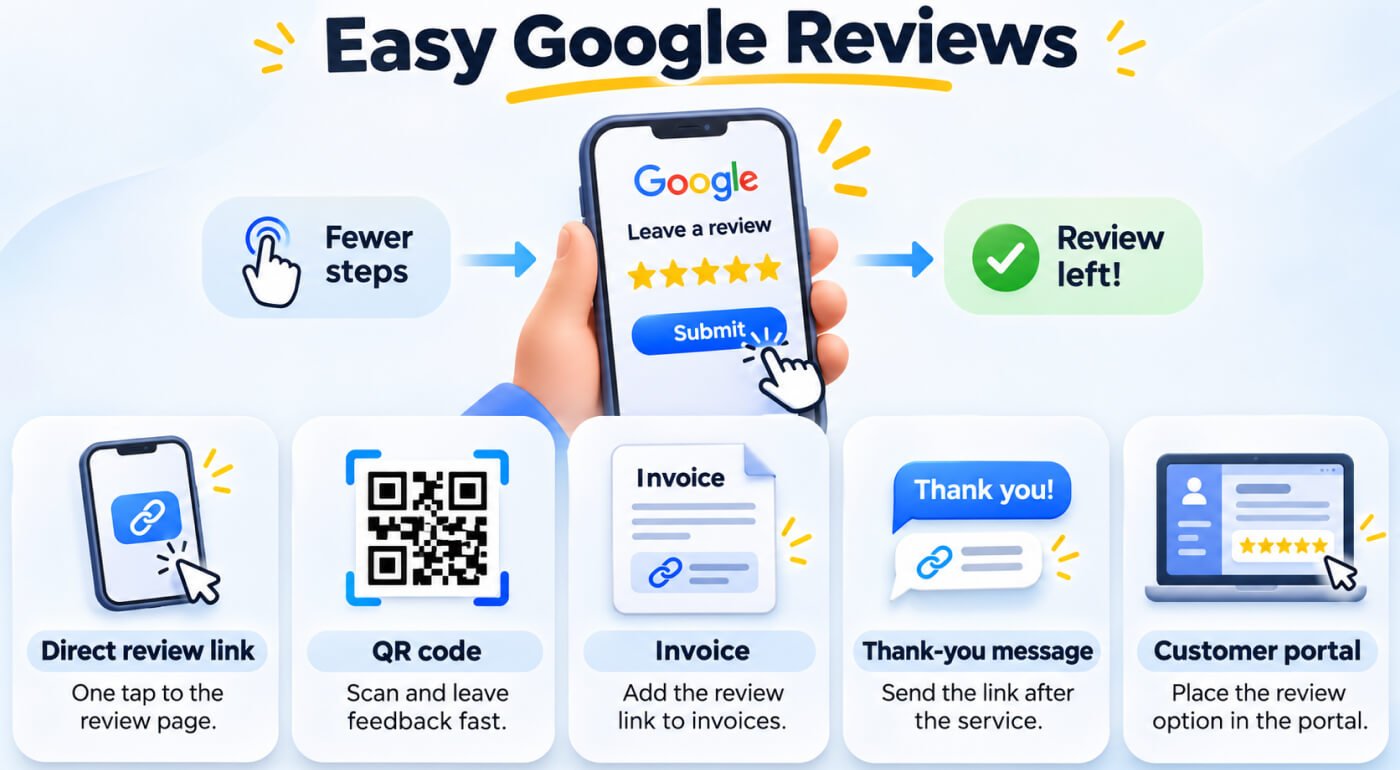
Make the review journey as short as possible. Customers should not need to search for your business. They should not hunt for the review button either. Google lets businesses create a direct Google review link and QR code. Practically, these tools remove several steps. They also make honest feedback easier to share.
- Direct review link: Send customers straight to the review process.
- QR code: Give in-person customers a quick route from printed material.
- Invoice: Add the review link after completed work or payment.
- Thank-you message: Give one clear option to leave honest feedback.
- Customer portal: Show the review option after a completed service.
Open your Business Profile, choose Read reviews, then Get more reviews. You can save the QR code or copy the direct review link. Google says its built-in Google review QR code needs a computer browser. Also, customers need a Google Account to review but not a Gmail address. They can use an existing third-party email address.
What Should You Say When Asking for a Google Review?
Ask customers to share their real experience, not to leave five stars. Keep the message simple and avoid telling customers what words to use. Their review should reflect their own experience and language. That keeps the feedback useful and avoids shaping the rating. Google also tells businesses not to request specific review content.
- Face-to-face: Mention the review naturally, then let the customer do it later.
- SMS: Keep the message short and give one direct review link.
- WhatsApp: Thank the customer before asking for their honest feedback.
- Email: Explain how their experience can help future customers decide.
But why do the words matter? People often get many review requests, so another one can feel like marketing. Instead, explain that honest feedback can help future customers know what to expect. This gives the review a clearer purpose. As a result, customers may feel their time is more useful.
How Should You Follow Up If Someone Forgets?
A straightforward approach is to make the request and send one soft reminder. After that, stop. This is good advice, not a Google rule. Some businesses can cautiously test one more reminder. But too many messages can feel overwhelming. They can also make the customer experience worse still.
How Can Automation Help You Reach 500 Google Reviews Consistently?
Automation can make review requests consistent without making them artificial. Use a real customer event as the trigger. A completed appointment, paid invoice, delivered order or finished job can start the request. This connects review collection to normal business activity. It also reduces the chance that staff simply forget to ask.
- Use one clear customer-completion trigger.
- Send through an appropriate customer communication channel.
- Add the direct Google review link.
- Do not filter people by the rating you expect.
- Stop reminders when continued contact adds no useful value.
A completed customer survey can also trigger a review request. However, do not show Google only to customers who gave high scores. That would bring review gating back into the process. Handle complaints through a separate service process. Do not block the customer’s right to leave public feedback.
There is also a UK privacy point. If review messages also promote your business, check the UK rules. UK GDPR and PECR can apply in some cases. The key point is simple: review automation should support a real customer relationship. It should not become an excuse to send unrelated sales messages.
Which Numbers Show Whether Your Google Review Strategy Is Working?
A total review count shows where you are but not why you are growing. Actually, a few simple measures expose weak points faster. They show whether the problem sits in volume, coverage, timing, friction or wording. That makes your Google review management more useful than simply checking the total each morning.
- Eligible customers
- Customers actually asked
- Published reviews
- Request-to-review conversion
- Weekly review gain
- Average rating
- Days since the newest review
- Recurring review themes
- Useful review responses
Do not copy another company’s target percentages. Establish your own baseline and compare each month with earlier results. If many customers qualify but few receive requests, fix coverage. If requests go out but reviews stay low, check timing, wording and friction. That approach gives you evidence for the next change.
Businesses with more than one location need to track each Google Business Profile on its own. For example, 500 reviews across ten places is not the same as 500 on one profile. So, check each location separately. This can also show which branches are doing less well. Then you can improve the service or review process in the right place.
What Should You Learn From Your Reviews?
Reviews are also customer research. Look for repeated themes such as slow replies, helpful staff or delivery problems. Then use those patterns to improve the service itself. Better experiences create stronger customer trust and more natural review opportunities. Useful replies also matter more than repeating the same thank-you message under every review.
Will 500 Google Reviews Make Your Business Rank Higher?
No fixed number of Google reviews guarantees a higher local position. Google says local results mainly depend on relevance, distance and prominence. Review count and positive ratings can help local ranking. However, they are only part of the picture. A business with 500 reviews does not automatically beat one with 200.
Relevance means how well the profile matches the search. Distance means how far the business is from the person searching. Prominence shows how well known the business is. Reviews can help with prominence, but they are only one part of the picture. So, do not focus on one review number. Your full Business Profile also matters for Google reviews local SEO.
How Many 5 Star Reviews Do You Need to Go Up on Google?
Google publishes no fixed number of five-star reviews needed to move up. Also, rating maths and ranking are different questions. New five-star ratings can change your average score. They do not create a guaranteed local ranking jump. The result still depends on the wider factors Google uses for local search.
A steady flow of reviews can keep customer feedback fresh. However, Google does not say review speed is a separate local ranking factor. That difference is important. It keeps Google reviews local SEO advice clear and accurate. It also stops an unconfirmed idea from sounding like an official Google rule.
Can Buying Google Reviews Get You to 500 Faster?
Buying Google reviews can raise the visible number quickly. However, it does not create genuine customer feedback. Google prohibits reviews paid for directly or in kind. It also bans incentives for reviews. That covers discounts, free goods and free services. It also covers posting, changing or removing reviews for a benefit.
People searching buy reviews for Google usually want a faster route. The same applies to buy Google reviews UK and buy reviews for Google. However, speed does not remove the policy risk. UK consumer law also covers fake and misleading review practices. That makes buying Google reviews in the UK a wider issue than platform policy alone.
Google policy and UK law should not be mixed together. Google’s platform rules prohibit paid and incentivised reviews. UK consumer law also deals with fake and misleading review practices. The Digital Markets, Competition and Consumers Act rules took effect in April 2025. So, UK businesses should treat review collection as a real compliance issue.
UK enforcement is no longer only theoretical. In March 2026, the CMA opened five review-related investigations. They covered potentially fake or misleading practices. Those investigations did not themselves prove wrongdoing. One Feefo investigation was still listed as ongoing in September 2026. That shows why careful wording and fair systems matter.
Can I Pay to Get Google Reviews?
You can pay for private customer research or survey work in some situations. That is different from paying someone to publish a Google review. Google does not allow payment or benefits for reviews. That rule also covers changing or removing reviews. So, a paid workaround does not become acceptable just because it looks genuine.
Where Can I Buy Google Reviews Safely in the UK?
There is no safe way under Google’s rules to buy fake or rewarded reviews. So, a seller cannot make paid reviews acceptable just by calling them safe. Instead, earn real feedback from genuine customer experiences. If you are thinking about paid reviews, check Google’s rules and UK legal duties before spending any money.
Want to Strengthen Your Google Presence? Explore SMM Wise and see how its Google review support can fit your business goals.
What Mistakes Can Put Your Google Reviews at Risk?
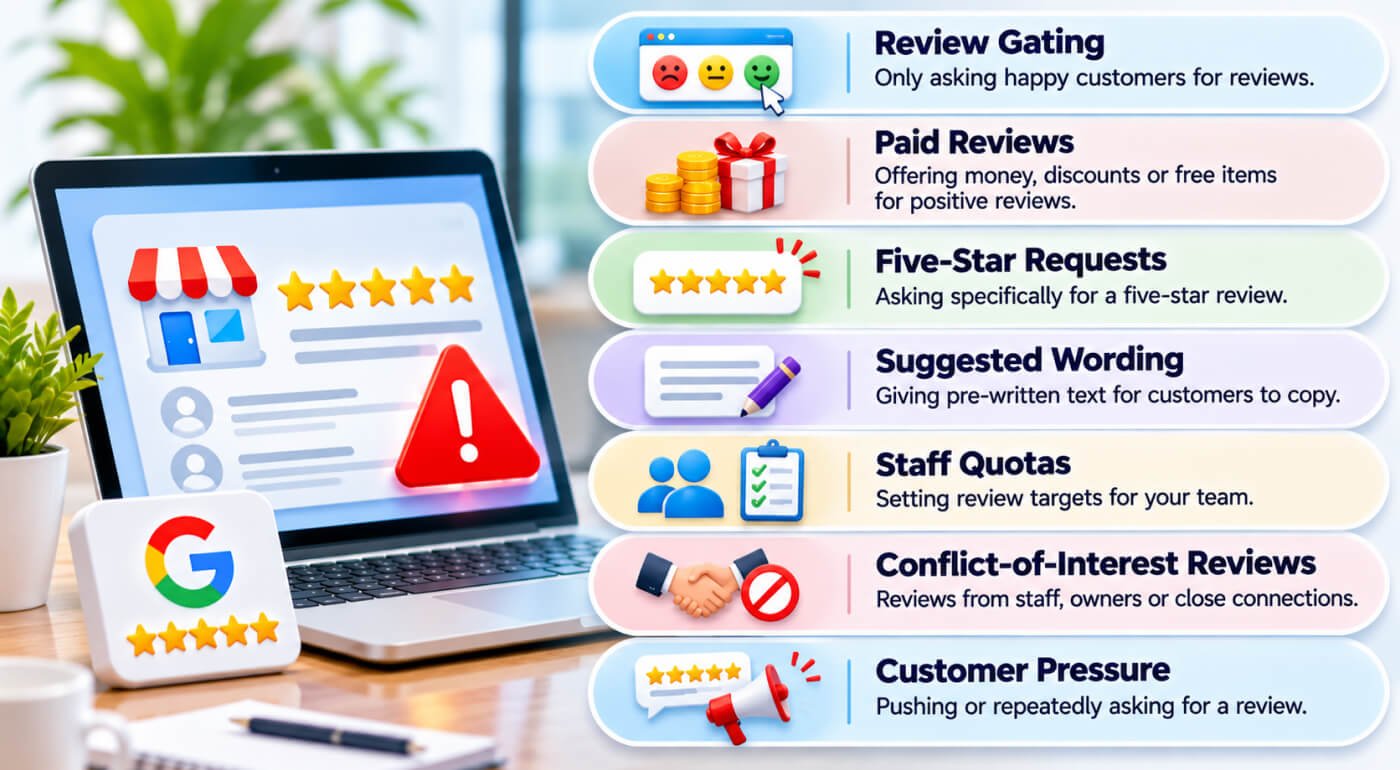
The biggest risks come from trying to control the rating. Honest feedback should stay in the customer’s hands. Google bans fake engagement, rating manipulation and selective positive solicitation. Practically, a short checklist can keep the process safer. It helps your team avoid pushing or shaping customer feedback.
- Review gating: Sending only likely positive reviewers to Google.
- Paid reviews: Giving money, discounts or benefits for published reviews.
- Five-star requests: Telling customers which rating they should choose.
- Suggested wording: Asking customers to mention set phrases or staff names.
- Staff quotas: Requiring workers to collect a fixed number of reviews.
- Conflict-of-interest reviews: Using staff, relatives or connected people artificially.
- Customer pressure: Repeated requests or pressure to review on-site.
Why Has a Genuine Google Review Not Appeared?
Google checks reviews against its content policies. Because of this, some reviews can take time to appear. Others can be removed. Delays can also happen after profile merges, while older devices can create posting problems. So, one missing review does not always mean the customer did anything wrong.
Do not ask the customer to post the same review again too soon. Instead, give it some time and check your profile again. If it is still missing, ask Google support for help. This can prevent extra confusion. It can also help you see if the review meets Google’s content rules.
Why Has My Google Rating Not Changed After a New Review?
Google calculates the score from published ratings. However, the displayed score does not always update at once. Google says the shown review score can update slowly. A new review can take up to two weeks to affect it. So, a short delay does not always mean the review failed. The profile might be fine.
What Should You Do Next to Reach 500 Google Reviews?
Learning how to get 500 Google reviews becomes easier when you stop treating 500 as one huge target. Break it into a system you can measure. Work out how many reviews you still need, how many real customers you serve and how often you ask. Then choose one natural review moment and remove every extra step between the customer and your Google review page.
The better alternative is to improve the process than to push more people through. So, look at where customers stop. Maybe too few get the request, the message comes too late or the link is hard to use. Fix that weak point and check the results again. Reaching 500 is only one step. A strong review system keeps bringing in real feedback long after that.
FAQs About How to Get 500 Google Reviews
1. How to get 1000 reviews on Google?
- To get 1,000 Google reviews, build a simple system that asks real customers for honest feedback. Use direct review links, QR codes and short reminder messages. This makes the process easier and saves you from asking each customer by hand.
2. Can Google detect fake reviews?
- Yes. Google uses automated systems and policy checks to find fake, paid or unusual review activity. Fake reviews can be removed and serious violations can lead to Business Profile restrictions.
3. How many Google reviews do I need to get 5 stars?
- There is no fixed number of reviews needed. Google works out your score from all published ratings. So, the number of new five-star reviews you need depends on your current rating and total number of reviews.
4. How can I get more Google reviews for free?
- Ask real customers for honest reviews and give them a direct Google review link or QR code. You can place the link in thank-you emails, receipts, messages or other suitable customer touchpoints.
5. Can you pay to get good Google reviews?
- No. Google prohibits paying customers or offering discounts, free goods or other benefits for reviews. Paid or incentivised reviews can be removed and can put your Business Profile at risk.
6. Can businesses delete Google reviews?
- Businesses cannot directly delete customer reviews just because they are negative. However, they can report reviews that break Google’s policies and Google can remove them after review.